
Is Shopify Worth It? An Honest Review for Small Businesses

Choosing the right e-commerce platform is one of the biggest decisions a business owner can make when building an online store.
The platform you choose impacts everything from your website design and customer experience to your ability to manage products, process payments, and scale your business over time.
With so many options available, many entrepreneurs find themselves asking the same question: is Shopify worth it?

Shopify has become one of the most popular e-commerce platforms in the world, powering millions of online stores across different industries.
From small businesses selling their first products online to established brands managing thousands of orders, Shopify provides a flexible platform designed to support businesses at different stages of growth.
However, popularity does not automatically mean it is the right choice for every business.
Before investing time and money into a platform, business owners need to understand how Shopify works, what features it provides, and whether it aligns with their specific goals.
Questions like is creating a Shopify store worth it, should I use Shopify, and how Shopify compares to other website builders are common among entrepreneurs planning their online growth strategy.
A platform that works well for a growing e-commerce brand may not be the best option for a small business launching its first product.
In this complete Shopify review for beginners, we will explore everything you need to know before choosing Shopify for your business.
We will cover the platform’s features, advantages, disadvantages, pricing considerations, competitors, and whether Shopify is the right fit for different types of businesses.

Our goal is to provide an honest and practical Shopify platform review that helps business owners understand not only what Shopify can do, but also whether it supports their current needs and future growth plans.
The right e-commerce platform is only one part of building a successful online presence. A professional website, strong branding, search engine optimization, and effective marketing strategy all play important roles in attracting customers and growing your business.
You can learn more about these foundations in our guide on the Benefits of Having a Business Website.
If you are comparing different platforms before making a decision, we recommend reading our read our Complete Review of the Best Website Builders for Small Businesses to understand how Shopify compares with other popular options.
You can also download our free e-book: Build Your Business's Online Presence in 90 Days to learn how to create a stronger digital foundation for your business.
By the end of this Shopify review, you will have a clearer understanding of whether Shopify is the right platform to help your business sell online, attract customers, and grow.
Is Shopify Worth It for Your Business? (Quick Summary of Our Review)
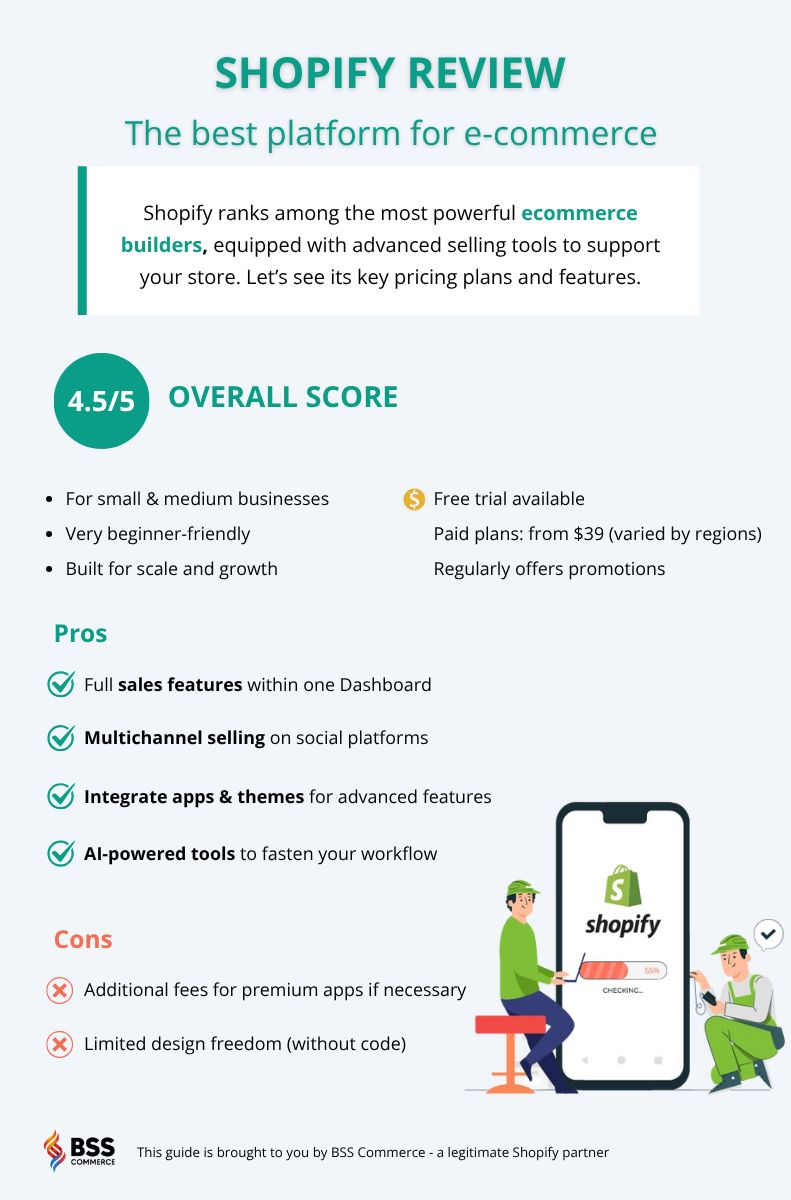
If you're asking if Shopify is worth it, the short answer is yes, but it depends on your business, your goals, and your level of experience with e-commerce.
After evaluating its features, scalability, ease of use, pricing, and long-term value, our conclusion is that Shopify is one of the best e-commerce platforms available for businesses that are serious about selling online and growing their store over time.
It provides a complete ecosystem for managing products, accepting payments, tracking inventory, marketing your business, and scaling your operations as your company grows.
Unlike many website builders that simply add online selling as an extra feature, Shopify was built specifically for e-commerce.
That difference becomes noticeable as your business expands.
Whether you're selling ten products or ten thousand, Shopify provides the tools needed to support long-term growth without requiring you to migrate to another platform later.
However, Shopify is not the perfect solution for every business.
While its flexibility and extensive features are major advantages, they also introduce additional complexity.
Many first-time business owners underestimate the amount of work involved in setting up an online store, configuring payments, shipping, taxes, inventory, apps, and marketing automation.
The platform also comes with ongoing monthly costs, and many businesses eventually purchase premium themes or third-party apps that increase their investment.
This is why you'll find many positive reviews, but also some mixed Shopify reviews online.
Businesses with ambitious growth plans often praise Shopify because it provides virtually everything needed to build and scale an online store.
On the other hand, entrepreneurs launching their very first business with a limited budget may find the platform more expensive and more complicated than expected.
For most small and medium-sized businesses, Shopify offers excellent long-term value.
Its ability to grow alongside your business often outweighs the higher monthly investment.
However, if you're launching a simple home-based business, testing a new product idea, or operating with a very limited budget, a simpler platform such as Square Online or Wix may provide a more practical starting point.
The most important question is not simply whether Shopify is worth the money.
The better question is whether Shopify is the right platform for where your business is today, and where you want it to be in the future.

What Is Shopify?
Shopify is a cloud-based Shopify eCommerce platform designed to help businesses create, manage, and grow an online store without needing to build everything from scratch.
Instead of purchasing web hosting, installing software, configuring security, and managing updates yourself, Shopify provides an all-in-one platform that combines website hosting, e-commerce tools, payment processing, inventory management, and marketing features in a single system.
For many business owners asking Shopify is it worth it, understanding what Shopify actually does helps explain why it has become one of the world's most popular e-commerce solutions.
Rather than functioning as a traditional website builder, Shopify is designed around one primary goal: selling products online.
Every feature within the platform is built to support that objective.
From product management and checkout optimization to shipping integrations and abandoned cart recovery, Shopify focuses on helping businesses create an efficient online shopping experience.
Because Shopify is fully hosted, business owners don't need to worry about maintaining servers, installing software updates, or managing website security.
These technical responsibilities are handled by Shopify, allowing businesses to spend more time focusing on sales, customer experience, and marketing.
Another major advantage is scalability.
Many website platforms become increasingly difficult to manage as a business grows.
Shopify is designed to support businesses at every stage, from entrepreneurs launching their first Shopify online store to established brands processing thousands of orders every day.
This makes Shopify a platform that many businesses can continue using for years without needing to migrate to a different system.
What Can You Sell on Shopify?
One of Shopify's biggest strengths is its flexibility.
The platform supports far more than traditional retail products, making it suitable for businesses across a wide range of industries and business models.
Whether you're selling physical goods, digital products, subscriptions, or services, Shopify provides the tools needed to build and manage an online store.
Many Shopify experts review the platform positively because it can adapt as a business evolves, allowing owners to expand their offerings without changing platforms.
While Shopify offers tremendous flexibility, businesses should also understand that some advanced selling capabilities require third-party apps or higher-tier plans. These additional features contribute to Shopify's scalability but may also increase ongoing costs, making them some of the Shopify drawbacks to consider before launching.

Physical Products
Shopify was originally built for selling physical products, making this its strongest capability.
Businesses can sell everything from clothing and electronics to furniture, home décor, automotive parts, handcrafted products, and specialty retail items.
The platform includes built-in inventory management, shipping integrations, tax calculations, discount codes, and order management tools that simplify day-to-day operations.
For retailers looking to scale, these are some of the biggest Shopify benefits, as the platform is designed to handle both small product catalogues and large inventories with thousands of products.

Digital Products
Shopify also supports digital products such as e-books, online courses, templates, software, music, photography, and downloadable resources.
By integrating digital delivery apps, businesses can automatically send purchased files to customers after checkout.
This makes Shopify an attractive solution for creators, educators, consultants, and entrepreneurs looking to generate passive income through digital products.

Services
Although Shopify is primarily an e-commerce platform, service-based businesses can also use it effectively.
Businesses offering consultations, coaching, photography, repairs, design services, or professional services can integrate appointment booking applications that allow customers to purchase and schedule services directly through the website.
This creates a streamlined experience where customers can learn about your services, make a purchase, and book an appointment all in one place.

Subscription Products
Recurring revenue has become increasingly popular for many businesses.
Shopify supports subscription-based selling through specialized apps that allow customers to receive products or services on a recurring schedule.
Examples include subscription boxes, coffee deliveries, pet supplies, health products, memberships, and digital subscriptions.
This provides businesses with predictable monthly revenue while improving customer retention.

Who Shopify Is Designed For
Shopify is designed for businesses that want to build an online store with long-term growth in mind.
While almost any business can use the platform, it delivers the greatest value to companies that expect their online sales to expand over time.
If you're wondering if a Shopify store is worth it, the answer depends less on your current size and more on your long-term business goals.
Shopify is built to grow alongside your business, making it an excellent investment for companies that plan to continuously expand their products, customers, and operations.
Small to Medium-Sized Businesses
For most small and medium-sized businesses, Shopify strikes an excellent balance between ease of use and scalability.
Business owners gain access to professional e-commerce features without needing enterprise-level technical knowledge.
As sales increase, Shopify continues providing the tools needed to support larger inventories, additional staff, more customers, and expanded marketing efforts.
For many growing businesses, this makes Shopify one of the strongest long-term investments available.
Growing E-Commerce Brands
Businesses planning to aggressively grow their online sales often benefit the most from Shopify.
Whether the goal is expanding into new markets, increasing product offerings, or automating operations, Shopify provides a platform that scales with the business.
Instead of outgrowing the platform after a few years, many businesses continue using Shopify throughout every stage of growth.
Retail Stores Expanding Online
Many brick-and-mortar businesses use Shopify to complement their physical locations.
Retailers can synchronize inventory between their physical stores and online stores, allowing customers to shop through multiple channels while maintaining accurate inventory levels.
This creates a seamless omnichannel experience that is increasingly important for modern consumers.
Entrepreneurs & First-Time Business Owners
One of the most common questions is whether Shopify is good for beginners.
The answer is yes, but with some important considerations.
Shopify has an intuitive interface, excellent documentation, and a large support community, making it accessible for new entrepreneurs.
However, building a successful online store involves much more than learning the software.
Business owners still need to understand product management, pricing, marketing, shipping, taxes, customer experience, and conversion optimization.
Compared to platforms like Wix or Square Online, Shopify offers significantly more features, but that also creates a steeper learning curve.
Is Shopify Easy to Use?
Another common question business owners ask is is Shopify easy to use.
Compared to many enterprise e-commerce platforms, Shopify is very user-friendly.
Its dashboard is well organized, the interface is modern, and most daily tasks can be completed without coding knowledge.
However, building a successful online store requires much more than learning where the buttons are.
While the software itself is relatively easy to navigate, maximizing everything Shopify offers takes time, planning, and experience.
For businesses committed to long-term growth, that learning investment is often well worth it.
Shopify Features Review
When evaluating whether is Shopify worth it, one of the most important factors to consider is the platform’s feature set.
Unlike traditional website builders that add e-commerce capabilities as an additional feature, Shopify was created specifically to help businesses sell online.
This focus is reflected throughout the platform.
From building a professional online store to managing products, processing payments, tracking inventory, and supporting marketing efforts, Shopify provides a complete ecosystem designed for e-commerce growth.
In this Shopify review, we’ll break down the most important Shopify features and explain how each one can help businesses create a more effective online store.
While Shopify offers an impressive range of tools, the right choice depends on your business goals, technical experience, budget, and long-term growth plans.
A simple store with a few products may not need every feature Shopify provides, while a growing brand may quickly benefit from the platform’s advanced capabilities.
For businesses building a digital presence beyond just an online store, many of these principles overlap with the features that create a strong business website. You can learn more about essential website functionality in our guide on Top Features for a Business Website.

Website Builder
One of Shopify’s biggest strengths is its ability to create professional e-commerce websites without requiring businesses to build everything from the ground up.
Many business owners ask, how does Shopify work, especially if they are comparing it to platforms like WordPress, Wix, or custom-built websites.
Shopify operates as an all-in-one hosted website platform.
This means Shopify manages the technical foundation of your online store, including hosting, security, software updates, and core e-commerce functionality.
Instead of managing servers or installing complicated software, business owners can focus on creating products, marketing their brand, and serving customers.
Build a Professional Online Store Without Coding & Website Development
Shopify provides a collection of customizable themes that allow businesses to create visually appealing storefronts.
Users can customize layouts, colours, fonts, images, navigation menus, and product pages to match their brand identity.
For businesses that want a more unique design, Shopify also allows advanced customization through coding and developer tools.
This flexibility makes Shopify suitable for both beginners and businesses that require more advanced functionality.
The platform can support a simple startup store while also powering complex e-commerce experiences for established brands.
Mobile-Friendly Store Design
Mobile optimization is essential for modern e-commerce.
A large percentage of online shopping happens through smartphones, meaning businesses need websites that provide a smooth experience across all devices.
Shopify themes are designed with responsive layouts that automatically adjust for desktop, tablet, and mobile users.
This helps ensure customers can browse products, add items to their cart, and complete purchases regardless of the device they use.
Should You Build Your Website on Shopify?
For businesses primarily focused on selling products online, Shopify is one of the strongest website platforms available.
If you are asking should I build my website on Shopify, the answer depends on what role your website plays.
For an e-commerce business where online sales are the primary focus, Shopify provides significant advantages.
It offers built-in tools for selling, managing orders, processing payments, and scaling operations.
However, businesses that require highly customized websites, extensive content marketing platforms, or complex service-based functionality may find other platforms better suited for their needs.
The key consideration is whether e-commerce is the foundation of your business.
If selling online is central to your growth strategy, Shopify provides one of the most complete solutions available.

Product Management
Product management is one of the most important parts of running an online store.
A successful e-commerce website needs more than just product images and prices.
Businesses need tools to organize products, manage variations, update information, and create a smooth shopping experience.
This is one area where Shopify performs exceptionally well.
For businesses wondering what Shopify is used for, product management is one of the platform’s core purposes.
Shopify provides businesses with the tools needed to organize and sell products efficiently, whether they have a small catalogue or thousands of items.
Easily Add and Organize Products
Shopify makes it simple to create product listings with detailed information.
Businesses can add:
Product names.
Descriptions.
Images and videos.
Pricing.
Inventory information.
Shipping details.
Product categories.
This allows businesses to create professional product pages that provide customers with the information needed to make purchasing decisions.
A well-optimized product page can significantly improve customer confidence and increase conversion rates.
Manage Product Variations
Many businesses sell products with different options.
A clothing company may offer different sizes and colours.
A furniture company may offer different materials.
A food company may offer different package sizes.
Shopify allows businesses to create product variants that make managing these options easier.
Customers can select their preferred option directly from the product page while Shopify tracks inventory for each variation.
Create Better Customer Shopping Experiences with Collections
Product organization directly impacts how customers navigate an online store.
Businesses can create collections and categories that help shoppers discover products more easily.
An outdoor equipment company could organize products into:
Camping gear.
Hiking equipment.
Winter products.
Accessories.
This creates a better browsing experience while helping customers find what they need faster.
Inventory Management
Managing inventory efficiently is critical for any business selling physical products.
Poor inventory management can lead to overselling, stock shortages, delayed orders, and frustrated customers.
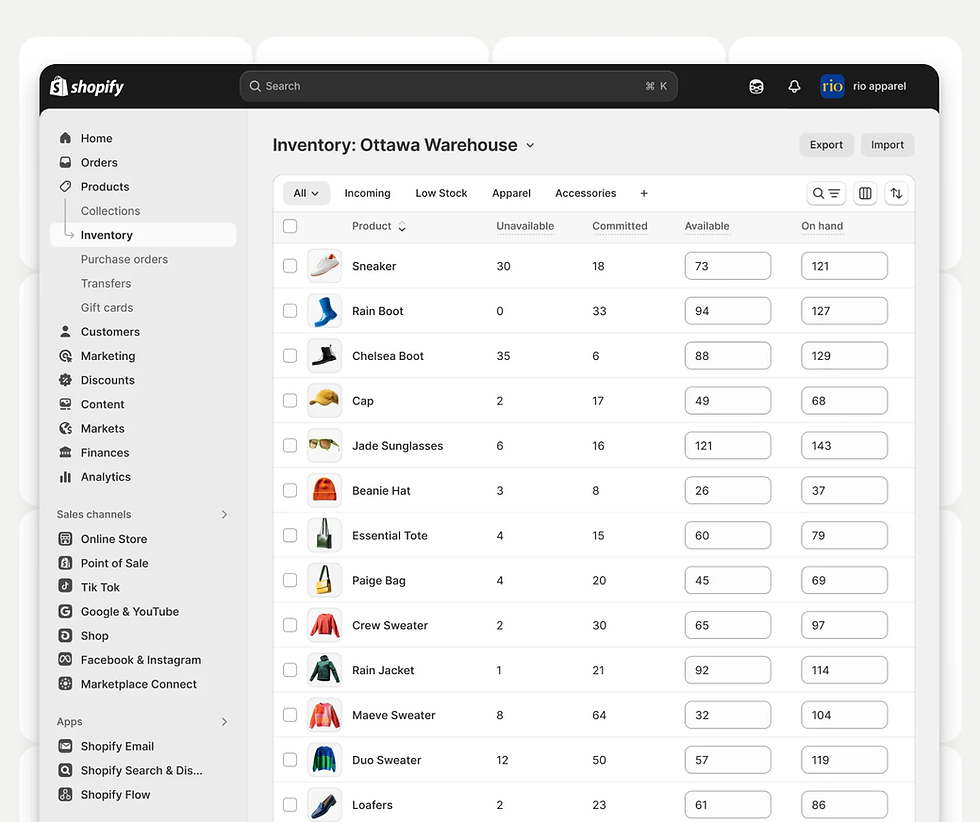
Shopify includes built-in inventory management tools that help businesses monitor products, track stock levels, and manage orders more effectively.
For growing businesses, this is one of the features that can make Shopify a worthwhile long-term investment.
Track Product Availability
Shopify allows businesses to monitor inventory levels directly within the platform.
When customers purchase products, inventory quantities can automatically update.
This gives business owners better visibility into what products are available and when items need to be restocked.
For businesses with multiple products, this reduces the manual work required to manage inventory.
Manage Inventory Across Multiple Sales Channels
Many businesses sell through more than one channel.
A company may sell products through:
Their website.
Physical retail locations.
Social media platforms.
Online marketplaces.
Shopify allows businesses to connect multiple sales channels and manage inventory from one central system.
This creates a more consistent experience and reduces the risk of inaccurate stock information.

Checkout Experience
The checkout experience is one of the most important parts of any online store.
A customer may spend several minutes browsing products, comparing options, and adding items to their cart, but a complicated checkout process can cause them to abandon their purchase before completing the transaction.
This is where Shopify performs extremely well.
A major reason many businesses consider is Shopify good for small businesses is because Shopify provides a streamlined checkout experience designed specifically for online sales.
Unlike many website builders that require additional tools or complicated integrations to create a reliable checkout system, Shopify includes a fully integrated checkout process from the beginning.
A Simple and Optimized Checkout Process
Shopify’s checkout system is designed to reduce friction and help customers complete purchases quickly.
Customers can easily review their cart, enter shipping information, select payment options, and finalize their orders through a clean and professional interface.
This simplicity matters because every additional step in the checkout process creates another opportunity for customers to leave.
A well-designed checkout experience can improve conversion rates by making purchasing feel easy, secure, and convenient.
Mobile-Friendly Checkout Experience
Mobile shopping continues to grow, making mobile checkout optimization essential for e-commerce businesses.
Shopify’s checkout is designed to work smoothly across smartphones, tablets, and desktop devices.
Customers can complete purchases without dealing with complicated forms, difficult navigation, or poor mobile layouts.
For small businesses competing with larger brands, providing a professional mobile experience can significantly improve customer trust.

Payment Processing
Reliable payment processing is essential for any successful online store.
Customers expect secure, flexible, and convenient payment options when shopping online.
As part of this Shopify eCommerce review, payment processing is one of the areas where Shopify provides significant value.
Shopify includes built-in payment solutions that allow businesses to accept payments without requiring complicated third-party integrations.
Shopify Payments is Shopify’s built-in payment processing system.
It allows businesses to accept major payment methods, including credit cards and digital wallets, directly through their online store.
Because it is integrated directly into the platform, businesses can manage payments, orders, and transactions from one centralized dashboard.
This simplifies store management and reduces technical complexity.
Multiple Payment Options for Customers
Modern customers expect flexibility when completing purchases.
Shopify supports various payment methods, including:
Credit cards.
Debit cards.
Digital wallets.
Buy-now-pay-later options.
Alternative payment providers.
Offering multiple payment methods can improve conversion rates because customers can choose the option that works best for them.
Shopify also provides built-in security features, including SSL encryption and PCI compliance, helping businesses create a safer shopping experience.
Shopify's Payment Processing Costs
Businesses should consider payment processing fees when evaluating Shopify.
Depending on the payment method, Shopify plan, and third-party payment providers used, transaction fees may apply.
This is an important factor when determining whether Shopify fits your budget.
A complete Shopify platform review should consider not only monthly subscription costs but also the ongoing expenses associated with running an online store.

Shipping Features
Shipping can be one of the most challenging parts of running an online store.
Businesses need to manage delivery options, shipping rates, tracking information, and customer expectations.
Shopify provides a range of shipping tools designed to simplify this process.
For businesses considering Shopify for small businesses, these features can significantly reduce the complexity of managing online orders.
Flexible Shipping Options
Shopify allows businesses to create different shipping methods based on their products and customers.
Businesses can offer:
Flat-rate shipping.
Free shipping.
Local delivery.
Pickup options.
Calculated shipping rates.
This flexibility allows businesses to create shipping strategies that match their products and customers.
While Shopify provides excellent shipping tools, businesses still need to develop a clear shipping strategy.
Factors such as packaging costs, delivery times, return policies, and carrier reliability still require careful planning.
A great platform cannot replace a well-designed fulfillment process.
Built-In Marketing Features
Building an online store is only one part of running a successful e-commerce business.
Businesses also need effective marketing strategies to attract visitors, convert customers, and encourage repeat purchases.
One reason many businesses ask should I use Shopify is because the platform includes built-in marketing features that support online growth.
When reviewing Shopify from a marketing perspective, the Shopify SEO review is especially important because visibility plays a major role in attracting customers.
Search Engine Optimization Tools
Shopify includes several built-in SEO features designed to help businesses improve their visibility in search engines.
The platform allows businesses to customize important SEO elements such as page titles, meta descriptions, image information, and website content.
Shopify also automatically creates important technical SEO elements, including XML sitemaps and mobile-friendly website structures.
While Shopify SEO may not provide the same level of customization as some open-source platforms, it offers a strong foundation for many businesses.
Email Marketing & Customer Retention
Successful e-commerce businesses understand that growth is not only about acquiring new customers.
Keeping existing customers engaged is equally important.
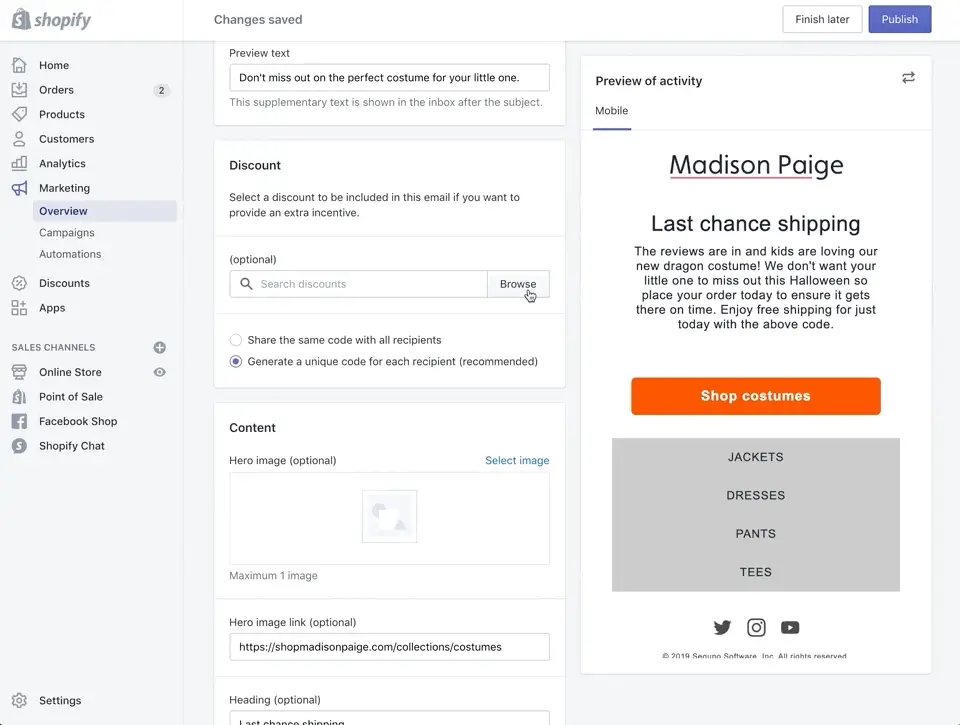
Shopify integrates with email marketing platforms that allow businesses to create campaigns for product launches, promotions, abandoned cart reminders, and customer follow-ups.
These tools help businesses build stronger relationships with customers and increase repeat purchases over time.
Promotions & Discount Strategies
Shopify provides built-in tools for creating discounts and promotional campaigns.
Businesses can create limited-time offers, percentage discounts, free shipping promotions, and customer-specific incentives.
These tools allow businesses to test different marketing strategies and understand what encourages customers to purchase.
Is Shopify Worth It for Marketing?
For businesses looking for an all-in-one e-commerce platform, Shopify provides valuable marketing capabilities.
However, Shopify should be viewed as the foundation of an online marketing strategy rather than the entire strategy itself.
Businesses still need strong branding, content marketing, SEO, advertising, and customer engagement efforts to generate consistent growth.
Shopify provides the tools, but businesses still need a strategy to use them effectively.
Analytics Dashboard
Data is one of the most valuable resources for improving an online store.
Without accurate information, businesses are forced to make decisions based on assumptions rather than customer behaviour.
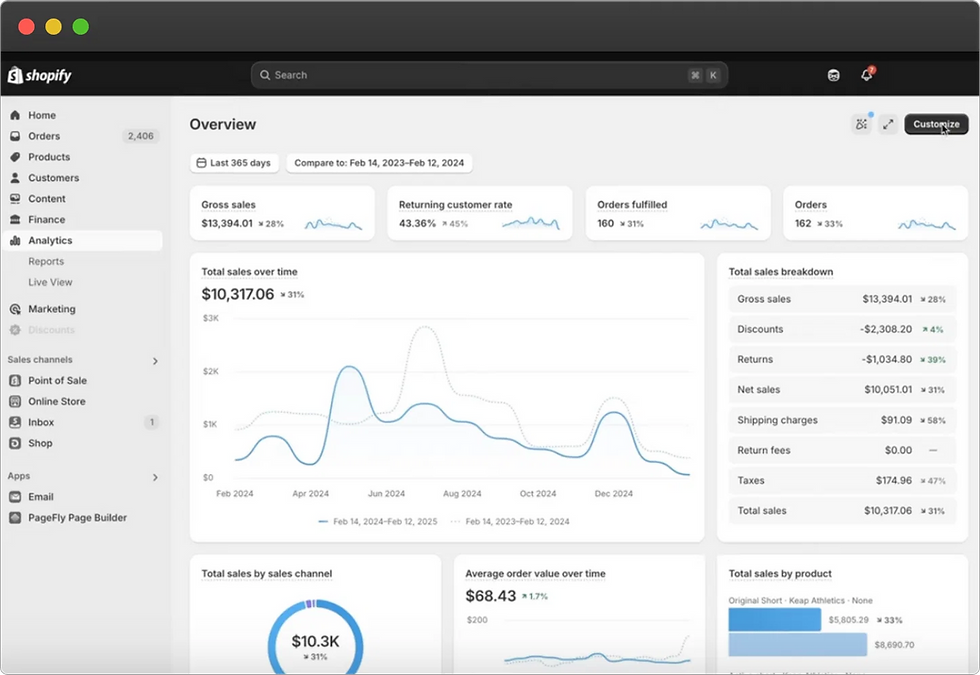
Shopify provides analytics tools that help businesses understand sales performance, customer activity, and overall store growth.
This is an important factor when evaluating whether Shopify is worth it for your business.
Track Sales Performance
Shopify analytics provides insights into important business metrics, including revenue, order volume, average order value, and customer activity.
These insights help businesses understand which products perform well, which marketing efforts generate sales, and where opportunities exist for improvement.
Instead of guessing what customers want, businesses can make decisions based on real data.
Understand Customer Behaviour
Shopify analytics also helps businesses understand how customers interact with their online store.
Businesses can analyze customer behaviour, traffic sources, purchasing patterns, and product performance.
For example, if a business notices that customers frequently visit a product page but rarely purchase, it may indicate an issue with pricing, product information, or the checkout experience.
These insights allow businesses to continuously improve their store.
The true value of analytics comes from using information to make better decisions.
Successful online stores constantly test, improve, and optimize their customer experience.
A strong Shopify review should consider not only the features available but also how effectively those features help businesses grow.
For a deep dive into understanding web analytics, read our Complete Guide to Web Analytics.

App Store
One of Shopify’s biggest advantages is its extensive app ecosystem.
The Shopify App Store allows businesses to add additional functionality without requiring custom development.
This flexibility is one of the reasons many Shopify reviews for small businesses are positive.
Businesses can start with Shopify’s core features and expand their store as their needs change.
Shopify apps allow businesses to add advanced features that support different business goals.
A company may add tools for customer reviews, email marketing, subscriptions, loyalty programs, SEO improvements, accounting, or inventory management.
This allows businesses to create a customized e-commerce experience based on their unique requirements.
Build a Store That Grows With Your Business
One of Shopify’s biggest strengths is that businesses do not need to invest in every feature immediately.
A new business can start with the basics and gradually add functionality as sales increase.
For example, a small retailer may initially need only products, payments, and shipping.
Later, as the business grows, they may add advanced marketing tools, automation systems, and customer retention features.
This flexibility is one of the biggest reasons businesses consider is Shopify worth it.
While Shopify’s app ecosystem is powerful, businesses should use it strategically.
Installing too many apps can increase monthly costs, create unnecessary complexity, and potentially impact website performance.
The goal should not be to install as many apps as possible.
The goal should be selecting the right tools that directly support business growth.
A successful Shopify store is not built with the most apps.
It is built with the right strategy, strong customer experience, and tools that solve real business challenges.

Shopify Pros & Cons
Before investing in an e-commerce platform, businesses need to understand both the opportunities and limitations that come with their decision.
While Shopify is one of the most popular e-commerce platforms in the world, it is not automatically the right choice for every business.
The best platform depends on your products, budget, technical experience, growth goals, and the type of online experience you want to create.
When researching Shopify pros and cons, it is important to look beyond basic feature comparisons.
A platform may have impressive tools, but those tools only create value when they align with your business needs.
After reviewing hundreds of online stores and evaluating the platform from a business growth perspective, Shopify stands out as a powerful solution for companies that want to build a scalable e-commerce operation.
However, smaller businesses, first-time entrepreneurs, and businesses with limited budgets should carefully consider the investment and complexity involved.
Many reviews of the Shopify website experience reflect this same pattern.
Businesses that need advanced e-commerce capabilities often praise Shopify’s flexibility and reliability, while businesses looking for a simple and inexpensive online store may find the platform more than they need.
Understanding the pros and cons of using Shopify will help you determine whether the platform supports your current situation and future goals.
The Pros of Using Shopify
Shopify has become one of the leading e-commerce platforms because it solves many of the challenges businesses face when selling online.
From website creation and payments to marketing and scalability, Shopify provides a complete ecosystem designed specifically for e-commerce.
For businesses that are serious about growing their online sales, these Shopify advantages can create significant long-term value.
Easy Setup
One of Shopify’s biggest advantages is how quickly businesses can create an online store.
Unlike traditional website development, where businesses may need to manage hosting, security, plugins, updates, and technical configurations, Shopify provides an all-in-one platform where many essential tools are already built in.
This makes launching an online store significantly easier for business owners who may not have technical experience.
The setup process allows businesses to choose a theme, add products, configure payments, set up shipping options, and begin accepting orders without building the entire system from scratch.
Excellent Performance & Reliable Hosting
Website performance plays a major role in e-commerce success.
Slow websites can frustrate customers, reduce conversions, and negatively impact search visibility.
Shopify provides reliable hosting infrastructure designed specifically for online stores.
Businesses do not need to manage servers, security updates, or technical maintenance.
Instead, Shopify handles much of the backend infrastructure, allowing business owners to focus on selling and growing their business.
One of the biggest advantages of using a hosted platform like Shopify is reliability.
The platform includes secure hosting, SSL certificates, and technical infrastructure designed to support online transactions.
Large App Ecosystem
Another major advantage of Shopify is its extensive app ecosystem.
The Shopify App Store allows businesses to add additional functionality without requiring custom development.
This gives businesses the ability to customize their store based on their specific needs.
For example, a business can add tools for customer reviews, email marketing, subscriptions, loyalty programs, inventory management, accounting, and advanced analytics.
One reason many businesses choose Shopify is because they do not need every feature immediately.
A small business can begin with a simple store and gradually expand its capabilities as revenue increases.
This scalability makes Shopify attractive for businesses that want to avoid migrating platforms later.
Instead of rebuilding their website when their needs change, businesses can continue improving their existing Shopify store.
SEO Features
Search engine visibility is essential for e-commerce success.
A beautiful online store does not generate sales if customers cannot find it.
Shopify includes several built-in SEO features that help businesses optimize their websites for search engines.
This is one reason many businesses researching Shopify advantages consider it a strong option.
While Shopify SEO has some limitations compared to fully customizable platforms, it provides enough functionality for many businesses to compete effectively.
SEO success requires more than technical features.
Businesses still need keyword research, content creation, product optimization, internal linking, and ongoing improvements.
Shopify provides the tools, but businesses need a complete SEO strategy to maximize results.
Scalability
One of Shopify’s biggest strengths is its ability to grow with a business.
Many businesses start small but eventually need more advanced tools, better automation, and stronger operational systems.
Shopify is designed to support this growth.
A business can start with a small product catalog and gradually expand into a larger online operation.
As the business grows, Shopify can support more products, higher order volumes, additional sales channels, and advanced integrations.
This makes Shopify a strong long-term investment for businesses with ambitious growth goals.
Many business owners ask is Shopify worth it for a small business.
The answer depends on the type of small business.
For businesses planning to grow their online sales, invest in e-commerce, and build a long-term brand, Shopify can provide excellent value.
However, smaller businesses with only a few products, limited budgets, or minimal e-commerce experience may find simpler platforms more practical.
Understanding the pros and cons of Shopify before making a decision is important before investing the time or money into a Shopify site.
The Cons of Using Shopify
While Shopify provides many powerful features, there are also several disadvantages businesses should consider.
Understanding the limitations of the platform helps create realistic expectations.
These Shopify disadvantages do not necessarily make Shopify a bad choice, but they are important factors when deciding whether it fits your business.
Steep Learning Experience
One of the biggest challenges with Shopify is that businesses often underestimate how much is involved in creating a successful online store.
The platform itself is relatively easy to navigate, but running an effective e-commerce business requires understanding many different areas.
A basic Shopify store can be launched quickly.
However, as businesses begin adding more products, apps, integrations, shipping rules, marketing tools, and automation systems, the platform becomes more complex.
This learning curve is one of the common themes found in Shopify reviews for small business.
Many new entrepreneurs enjoy the platform’s capabilities but are surprised by the amount of work required to maximize its potential.
Expensive Monthly Subscription
One of the most common concerns businesses mention when reviewing Shopify is the cost.
Compared to simpler website builders, Shopify requires a higher monthly investment.
For businesses with strong e-commerce goals, Shopify’s pricing can be justified by the features and scalability it provides.
However, for businesses with limited budgets, the ongoing costs may become difficult to manage.
This is why some Shopify online store reviews are mixed.
Businesses that generate consistent revenue often view Shopify as an investment.
Businesses still trying to validate their idea may view it as an unnecessary expense.
Transaction Fees
Transaction fees are another factor businesses should consider.
Depending on the payment method used and the Shopify plan selected, businesses may pay additional processing fees.
These costs can become more noticeable as sales volume increases.
For businesses with high transaction volumes, even small percentage fees can impact profitability.
When calculating whether Shopify is worthwhile, businesses should consider the complete cost of ownership.
The monthly subscription is only one part of running an online store. Businesses should also account for transcation fees, app subscriptions, domain subscription, and any professional services required to run the online store.
A realistic budget helps businesses determine whether Shopify fits their financial goals.
Dependency on Apps for Advanced Customization
Shopify’s app ecosystem is one of its greatest strengths, but it can also become a limitation.
Many advanced features require third-party applications.
While these apps add flexibility, they can increase costs and create additional complexity.
Businesses requiring highly specific functionality may eventually encounter Shopify’s limitations.
Highly customized workflows, unique checkout experiences, or complex business systems may require custom development or alternative solutions.
For most small and medium-sized businesses, Shopify provides more than enough flexibility.
However, companies with highly specialized requirements should evaluate whether the platform can support their long-term vision.
Is Shopify Right for Your Business?
Understanding the Disadvantages of Shopify does not mean Shopify is the wrong choice.
It simply means businesses need to choose a platform based on their actual needs.
For businesses asking is it worth selling on Shopify, the answer is often yes if they want a scalable, professional e-commerce platform designed for growth.
However, businesses looking for the cheapest or simplest way to sell a few products may find better options elsewhere.
The best e-commerce platform is the one that supports your current goals while giving you room to grow.
How Does Shopify Stand Aganist Their Competitors?
Choosing the right e-commerce platform is one of the most important decisions a business owner can make.
The platform you choose affects everything from website design and customer experience to marketing, scalability, and long-term growth.
While Shopify is one of the most recognized e-commerce platforms available, it is not the only option.
Businesses often compare Shopify against alternatives like WooCommerce, Wix, and Square Online to determine which solution provides the best value for their specific needs.
When reading Shopify website reviews, you will notice a common theme: Shopify is praised for its powerful e-commerce capabilities, scalability, and flexibility, but some businesses find it more expensive and complex compared to simpler platforms.
The right choice depends on where your business is today and where you want it to go in the future.
For businesses focused on long-term e-commerce growth, Shopify is often one of the strongest choices available.
However, businesses with smaller budgets, simpler needs, or limited technical experience may find other platforms better suited.
If you are comparing different website platforms, our Complete Guide to the Best Website Builder for Small Businesses provides a detailed overview of the top options available for small businesses.
Shopify vs WooCommerce
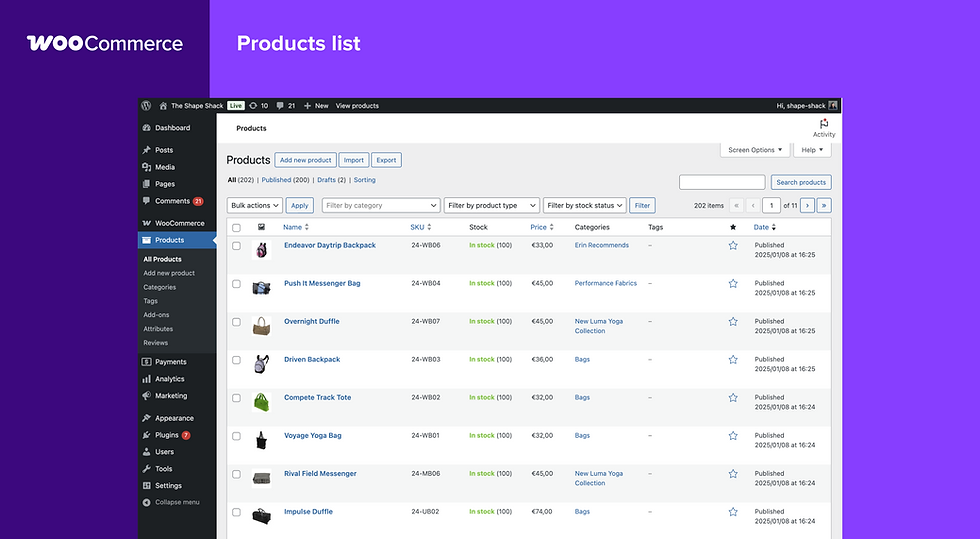
Shopify and WooCommerce are two of the most popular e-commerce platforms available.
However, they approach online selling in completely different ways.
Shopify is an all-in-one hosted e-commerce platform, while WooCommerce is an open-source e-commerce plugin built for WordPress websites.
The decision between the two often comes down to simplicity versus flexibility.
You can learn more about WordPress as an alternative through our Our Complete Review of WordPress.
Ease of Use
One of Shopify’s biggest advantages is simplicity.
Because Shopify is a fully hosted platform, businesses do not need to manage hosting, security updates, technical maintenance, or complicated installations.
WooCommerce provides significantly more control, but it also requires more technical management.
Businesses using WooCommerce typically need to manage their own hosting, plugins, updates, security, and website maintenance.
For business owners who want to focus primarily on selling products rather than managing technology, Shopify is often the easier choice.
Customization
WooCommerce offers exceptional customization because it is built on WordPress.
Businesses have almost unlimited control over their website structure, design, and functionality.
This makes WooCommerce a strong choice for businesses that require highly customized websites.
Shopify also provides significant customization through themes, developers, and apps.
However, because Shopify is a hosted platform, there are some limitations compared to the complete flexibility of WordPress.
For businesses that need a highly customized website experience, WooCommerce may provide more control.
SEO
Both platforms can perform well in search engines when properly optimized.
WooCommerce benefits from WordPress’s strong content management capabilities, making it popular among businesses that rely heavily on blogging and content marketing.
Shopify provides strong SEO foundations with built-in technical features, fast hosting, mobile-friendly themes, and easy product optimization.
The platform itself is not what determines SEO success.
Content quality, keyword strategy, website structure, user experience, and ongoing optimization have the greatest impact.
Shopify vs WooCommerce: Which One Is Better?
When businesses ask shopify any good, the answer depends on their priorities.
Shopify is usually the better option for businesses that want:
A simple setup process.
Reliable hosting.
A dedicated e-commerce platform.
Easy store management.
Strong scalability.
WooCommerce is often better for businesses that want:
Complete website control.
Advanced customization.
A content-focused website.
Greater technical flexibility.
For most small and medium-sized businesses looking to grow online, Shopify provides a more streamlined experience.
For businesses requiring complete control over every aspect of their website, WooCommerce may be the better fit.

Shopify vs Wix
Wix and Shopify are both popular website platforms, but they serve different purposes.
Wix is primarily a website builder that includes e-commerce functionality.
Shopify is an e-commerce platform designed specifically for selling online.
This difference is important when deciding whether it is worth it to sell on Shopify.
You can explore Wix further through our Our Complete Review of Wix.
E-Commerce Capabilities
Shopify has a clear advantage when it comes to advanced e-commerce features.
The platform was built specifically for online selling, meaning product management, inventory, checkout, payments, and order processing are central parts of the experience.
Wix works well for businesses that need a website with basic online selling capabilities.
For example, a service business selling a few products, a photographer selling prints, or a local business selling merchandise may find Wix sufficient.
However, businesses with larger product catalogs, complex inventory needs, or ambitious growth plans often benefit more from Shopify.
Ease of Use
Wix is often easier for beginners because of its visual drag-and-drop editor.
Business owners can quickly create pages and customize layouts without much technical knowledge.
Shopify is also user-friendly but has more e-commerce-specific settings and features.
This creates a slightly steeper learning curve.
The tradeoff is that Shopify provides more powerful selling tools.
Businesses need to decide whether simplicity or e-commerce functionality is more important.
Design Flexibility
Wix provides more flexibility when designing general website pages.
Businesses can move elements freely and create highly customized layouts.
Shopify focuses more on structured e-commerce design.
While Shopify themes are highly customizable, the platform prioritizes creating effective shopping experiences over unlimited design freedom.
For businesses where online selling is the main goal, Shopify’s structure is often beneficial.
Shopify vs Wix: Which One Is Better?
The answer depends on your business model.
Wix may be a better choice for:
Small service businesses.
Simple product sales.
Budget-conscious startups.
Businesses prioritizing website design flexibility.
Shopify may be better for:
Dedicated online stores.
Growing product businesses.
Retail companies.
Businesses planning long-term e-commerce growth.
For businesses asking is it worth it to sell on Shopify, the answer is usually yes if e-commerce is a major part of your growth strategy.

Shopify vs Square Online
Square Online is another popular option, especially among small businesses that already use Square payment systems.
Unlike Shopify, which is focused primarily on e-commerce growth, Square Online is designed to help small businesses quickly create an online store connected to their existing Square ecosystem.
Cost
One of the biggest advantages of Square Online is affordability.
Businesses can start with lower upfront costs, making it attractive for entrepreneurs testing an online selling idea.
Shopify generally requires a higher monthly investment but provides significantly more advanced e-commerce functionality.
For businesses just starting out, Square Online may provide an easier entry point.
For businesses planning to scale, Shopify often provides greater long-term value.
E-Commerce Features
Square Online works well for businesses that need basic online selling capabilities.
For example, restaurants, local retailers, and small businesses that already use Square may appreciate the seamless connection between online and in-person sales.
Shopify offers a broader range of e-commerce features, including advanced product management, marketing tools, apps, international selling capabilities, and scalability.
Businesses with more complex needs will generally find Shopify better equipped.
Growth Potential
The biggest difference between the two platforms is scalability.
Square Online is excellent for businesses that need a simple online presence connected to their existing operations.
Shopify is designed for businesses that want to build and grow an online brand.
As businesses expand, Shopify provides more opportunities for customization, automation, and advanced selling strategies.
Shopify vs Square Online: Which One Is Better?
When asking is it worth using Shopify, businesses should consider their long-term goals.
Square Online may be the better option if you:
Already use Square.
Have a small product catalog.
Need a simple online store.
Want minimal monthly costs.
Shopify may be the better option if you:
Plan to grow online sales.
Need advanced e-commerce features.
Want extensive customization.
See online selling as a major part of your business.
Ultimately, Shopify is not always the cheapest option, but it is one of the strongest platforms for businesses that want to build a scalable e-commerce operation.

Who Should Use Shopify?
Shopify is one of the most powerful e-commerce platforms available, but its value depends heavily on the type of business using it.
The platform is designed for businesses that view online selling as a long-term growth opportunity rather than simply a way to add a few products to an existing website.
For businesses wondering is it worth selling on Shopify, the answer depends on your goals, product strategy, budget, and willingness to invest in building an online store.
Shopify provides the most value for businesses that need scalability, advanced e-commerce features, and a platform that can grow alongside their operations.
Businesses Focused on E-Commerce Growth
Shopify is an excellent choice for businesses where online sales are a major part of their growth strategy.
Whether you are launching a new product brand or expanding an existing retail business, Shopify provides the tools needed to create a professional online shopping experience.
The platform allows businesses to start small and gradually add more products, features, integrations, and marketing tools as they grow.
This makes Shopify especially valuable for businesses that do not want to rebuild their website every few years as their needs become more complex.
Retail Businesses Expanding Online
Traditional retail businesses can benefit significantly from Shopify when transitioning into e-commerce.
A physical store can use Shopify to create an online sales channel while maintaining consistency between in-person and online operations.
Businesses can manage products, inventory, customer information, and orders from one centralized system.
For retailers looking to reach customers beyond their local area, Shopify provides the infrastructure needed to compete in a larger digital marketplace.
Businesses That Want an All-in-One E-Commerce System
Shopify is ideal for businesses that want multiple e-commerce tools connected within one platform.
Instead of managing separate systems for website hosting, payments, inventory, orders, and customer management, Shopify brings many essential functions together.
This reduces technical complexity and allows business owners to focus more time on marketing, sales, and customer experience.
Who Should Avoid Shopify?
While Shopify is a powerful platform, it is not the right solution for every business.
Some businesses may find that Shopify provides more features, complexity, and cost than they currently need.
Understanding when Shopify is not the right fit can help businesses avoid unnecessary expenses and choose a platform that better matches their current stage.
For businesses asking is making a Shopify store worth it, the answer depends on whether the platform aligns with their goals and resources.
Businesses Testing a New Idea With a Limited Budget
Entrepreneurs launching their first product idea may not always need Shopify immediately.
If you are still validating whether customers are interested in your products, investing in a more advanced e-commerce platform may not be necessary.
Shopify’s monthly subscription, apps, themes, and additional costs can add up quickly.
For businesses in the early testing phase, a simpler and lower-cost platform may provide a better starting point.
Once the business gains traction, moving to Shopify can become a more strategic investment.
Businesses Selling Only a Few Products
Not every business needs a full-scale e-commerce platform.
A business selling a small number of products may find Shopify offers more functionality than required.
For example, a local service business selling a few branded products, a photographer selling limited prints, or a consultant offering one digital product may not need Shopify’s full range of capabilities.
A simpler website builder with basic e-commerce features may provide everything they need.
Businesses With Very Limited Technical Experience and Support
Although Shopify is designed to be user-friendly, creating and managing a successful store still requires learning.
Business owners need to understand product management, website optimization, marketing, customer experience, and analytics.
Without the time or resources to learn these areas, businesses may struggle to take full advantage of the platform.
In these situations, working with an experienced e-commerce professional or choosing a simpler platform may be a better option.
Businesses Looking for the Cheapest Online Store Solution
Shopify is not designed to be the lowest-cost option available.
Businesses primarily focused on minimizing expenses may find cheaper alternatives that provide basic online selling functionality.
Platforms like Square Online or Wix can be better options for businesses that need a simple online presence without advanced e-commerce features.
However, businesses should also consider the long-term impact of choosing a cheaper platform.
Saving money upfront may create limitations later if the business grows and requires more advanced functionality.
Conclusion
So, is Shopify worth it?
For many businesses, the answer is yes.
Shopify is one of the most powerful and reliable e-commerce platforms available, offering the tools businesses need to build, manage, and scale an online store.
From product management and secure checkout to marketing tools, analytics, and thousands of customization options, Shopify provides a complete ecosystem designed specifically for online selling.
However, choosing the right platform is not only about features.
It is about finding a solution that matches your business goals, budget, experience level, and long-term growth plans.
For businesses that are serious about building an online store, expanding product sales, and creating a scalable e-commerce operation, Shopify offers significant advantages.
The platform provides the flexibility needed for businesses to start small and grow over time without needing to completely rebuild their online presence.
However, is Shopify worth it for small business owners who are just getting started?
The answer depends on your situation.
A small business with ambitious growth plans, a strong product offering, and a willingness to invest in online marketing can benefit greatly from Shopify.
On the other hand, a business selling only a few products, testing a new idea, or operating with a limited budget may find simpler platforms more practical in the beginning.
When looking at a Shopify website review, it is clear that the platform has both strengths and limitations.
Its biggest advantages are scalability, e-commerce functionality, reliability, and customization options.
Its biggest challenges are the learning curve, ongoing costs, and the need to carefully manage additional apps and features.
Ultimately, is it worth it to sell on Shopify comes down to your business strategy.
If e-commerce is a major part of your future growth plans, Shopify is one of the strongest investments you can make.
If you are looking for a simple and inexpensive way to test online selling, another platform may be a better starting point.
The important thing is choosing a platform that supports your customers, strengthens your brand, and gives your business room to grow.
Building a successful online presence requires more than choosing the right platform.
Your website, branding, SEO strategy, marketing channels, and customer experience all work together to create long-term growth.
If you are still building your digital foundation, download our free e-book: Build Your Business's Online Presence in 90 Days to discover the key steps for creating and improving your online presence.
You can also explore our Complete Guide to Building a Business Website to learn how to create a website that attracts customers, builds credibility, and supports your business goals.
Frequently Asked Questions (FAQ)
Is Shopify worth it for small business?
Shopify can be worth it for small businesses that want to build a scalable online store and make e-commerce a major part of their growth strategy.
The platform provides powerful tools for managing products, processing payments, tracking inventory, marketing products, and improving the customer shopping experience.
For small businesses planning to grow their online sales, Shopify offers long-term value because it can support expansion without requiring a complete website rebuild later.
However, Shopify may not be the best option for every small business.
Businesses with only a few products, limited budgets, or those testing a new idea may find simpler and lower-cost platforms more practical.
The best choice depends on your business goals, product strategy, and how seriously you plan to invest in e-commerce.
What are the disadvantages of Shopify?
The biggest disadvantages of Shopify are its cost, learning curve, and reliance on third-party apps for advanced features.
While Shopify is user-friendly compared to many e-commerce platforms, building a successful store requires learning how to manage products, optimize pages, improve conversions, and use marketing tools effectively.
Another disadvantage is that many advanced features require paid apps, which can increase monthly expenses over time.
Businesses should also consider transaction fees, premium themes, and additional software costs when calculating the total investment required to operate a Shopify store.
Is Shopify worth it to make money?
Shopify can be worth it for making money online, but the platform itself does not guarantee sales.
Shopify provides the tools needed to create an online store, but success depends on factors such as product quality, pricing, branding, marketing strategy, customer experience, and traffic generation.
Businesses that invest in SEO, paid advertising, content marketing, email marketing, and customer retention strategies are more likely to generate consistent revenue.
Shopify is best viewed as the foundation of an online business rather than a shortcut to making money.
What are the downsides of Shopify?
The main downsides of Shopify include ongoing costs, limited customization compared to fully open-source platforms, and the need for additional apps as your business grows.
While Shopify provides many built-in features, businesses often add apps for advanced functionality such as subscriptions, product customization, reviews, loyalty programs, and specialized marketing tools.
These apps can improve your store but may also increase expenses and create additional management requirements.
Another potential downside is that businesses looking for complete control over every aspect of their website may prefer platforms like WordPress and WooCommerce.
Who is Shopify's biggest competitor?
Shopify’s biggest competitors include WooCommerce, Wix, and Square Online.
WooCommerce is a popular alternative for businesses that want maximum customization and control through WordPress.
Wix is often preferred by smaller businesses that want an easy-to-use website builder with basic e-commerce functionality.
Square Online is commonly used by local businesses that already use Square payment systems and need a simple online store.
The best alternative depends on your business model.
For businesses focused heavily on e-commerce growth, Shopify remains one of the strongest options available because of its scalability, features, and ecosystem.
How much does an average Shopify store make?
There is no fixed amount that the average Shopify store makes because revenue varies significantly depending on the industry, products, pricing, marketing strategy, and customer demand.
Some Shopify stores generate only a few hundred dollars per month, while successful brands generate thousands or even millions in annual sales.
The biggest factors influencing Shopify revenue include:
The quality of the products being sold.
The effectiveness of marketing campaigns.
Website conversion rates.
Customer retention strategies.
Average order value.
Traffic volume.
A Shopify store is a tool that enables businesses to sell online, but profitability depends on how effectively the business uses the platform.
Is Shopify actually worth it?
Shopify is worth it for businesses that need a reliable, scalable, and professional e-commerce platform.
Its biggest strengths are its ease of use, powerful selling features, customization options, and ability to support business growth.
For entrepreneurs and companies that are serious about building an online store, Shopify can be an excellent long-term investment.
However, businesses should carefully consider their budget, technical experience, and growth plans before choosing the platform.
If you need a simple website with occasional online selling, Shopify may provide more functionality than necessary.
If your goal is to build a serious e-commerce business, expand your product offerings, and create a strong online sales channel, Shopify is one of the best platforms available.


%20-%20Text%20%26%20Icon%20-%20White%20(PNG)_edited.png)
Comments