
14 Digital Marketing Metrics and KPIs Every Business Should Track

Understanding how your marketing efforts perform is essential for growth. This is where digital marketing metrics and KPIs come in.
These key performance indicators help businesses measure the success of their campaigns, uncover areas for improvement, and make smarter, data-driven decisions.
Whether you’re running social media campaigns, email marketing, or paid advertising, knowing which metrics to track ensures that your efforts are aligned with your business goals.
Tracking the right metrics matters because it transforms guesswork into actionable insights.
By monitoring marketing KPIs to track, you can identify what’s driving results, what needs adjustment, and where to allocate resources for maximum impact. This approach allows businesses to optimize campaigns, reduce wasted spend, and ultimately improve ROI.
Some metrics are more important than others, and identifying the best marketing KPIs to track helps prioritize efforts that truly move the needle.
These are the most important KPIs to track for improved marketing, offering a clear view of audience engagement, conversions, revenue, and overall campaign performance.
To help you get started, we’ve created practical tools and resources:
Download our free Social Media Analytics Spreadsheet Template to track engagement, reach, and performance across platforms.
Download our free Website Analytics Spreadsheet Template to monitor traffic, conversions, and user behaviour on your website.
Learn how to grow your business using data-driven marketing with our complete free e-book guide on how to build your business's online presence in 90 days.
By the end of this guide, you’ll understand which digital marketing metrics and KPIs matter most for your business and how to leverage them to make informed decisions that drive growth.

ROAS (Return on Ad Spend)
Return on Ad Spend, or ROAS, is the most important metric that helps businesses determine the profitability of their advertising campaigns.
Essentially, it measures how much revenue is generated for every dollar spent on ads, providing a clear picture of campaign efficiency and overall marketing ROI.
ROAS is one of the most important digital marketing metrics and KPIs because it directly ties your advertising investment to measurable revenue.
A high ROAS indicates that your campaigns are generating more revenue than they cost, while a low ROAS highlights areas that need optimization.
A declining ROAS may indicate that your targeting needs adjustment, ad creatives aren’t resonating, or your bids are too high.
Monitoring ROAS regularly allows you to make data-driven decisions that improve efficiency and profitability.
For example, if you spend $500 on a Google Ads campaign and generate $2,500 in revenue, your ROAS is 5:1. This means for every $1 spent, you earned $5 in revenue.
To effectively track KPIs for marketing, ensure you have conversion tracking enabled in your ad platforms and use analytics tools to link conversions and revenue back to your campaigns.
ROAS is particularly useful for paid advertising channels like Google Ads, Meta Ads, and other PPC campaigns.
By incorporating ROAS into your regular reporting, you gain a clear understanding of which campaigns drive revenue, making it an indispensable metric for businesses looking to optimize advertising spend and scale growth.

Reach & Impressions
Reach and impressions are two essential digital marketing metrics and KPIs that measure how widely your content is being seen and how often it appears to your audience.
These metrics are especially important for campaigns focused on brand awareness, engagement, and overall visibility.
Reach
Reach refers to the total number of unique users who have seen your content or ad.
It tells you how many individual people your message is reaching across your marketing channels.
For example, if 1,000 different users see your Facebook ad, your reach is 1,000. Reach is a key indicator of audience exposure and brand visibility.
Impressions
Impressions measure the total number of times your content or ad is displayed, regardless of whether it’s clicked.
This includes repeated views by the same user.
For example, if your ad is shown 3,000 times but only 1,000 people saw it, your impressions are 3,000, while your reach is 1,000.
Both metrics help you understand the scale and frequency of your marketing efforts.
High reach ensures your brand is being exposed to new potential customers.
High impressions with moderate reach can indicate strong engagement or repeated exposure to your target audience, which helps reinforce brand recall.
Monitoring reach and impressions allows marketers to evaluate the effectiveness of campaigns designed to boost brand awareness.
If reach is low, you may need to expand targeting or increase ad spend. If impressions are low relative to reach, consider adjusting content placement or ad frequency.
By tracking reach and impressions, you can gauge how well your campaigns are introducing your brand to potential customers and influencing awareness, making these metrics a foundational part of your marketing strategy.

Conversion Rate
Conversion rate is one of the most important marketing KPIs to track because it directly measures how effectively your website or campaigns are turning visitors into leads, customers, or subscribers.
It is a key indicator of marketing efficiency and overall business performance.
Conversion rate calculates the percentage of users who complete a desired action, such as filling out a contact form, making a purchase, signing up for a newsletter, or downloading a resource.
For example, if 1,000 people visit your website and 50 take the desired action, your conversion rate is 5%.
As one of the most important key marketing metrics, conversion rate shows how well your marketing efforts are performing beyond just traffic numbers.
A high conversion rate indicates that your messaging, landing pages, and overall user experience are aligned with audience intent.
While conversion rates vary by industry, the general guideline is to always aim to keep your conversion rate higher by testing, refining, and optimizing campaigns. Even small improvements can have a significant impact on revenue.
Monitoring conversion rate as part of your marketing performance indicators allows you to make data-driven decisions that increase ROI and improve the effectiveness of every campaign. It’s one of the most actionable metrics for understanding whether your marketing strategies are truly driving business growth.

Cost Per Conversion (CPC)
Cost Per Conversion (CPC) is a vital metric that helps businesses understand the efficiency and profitability of their marketing campaigns. I
It measures how much it costs, on average, to acquire a lead, sale, or any desired action from your advertising efforts. This metric is important for budgeting and ad optimization, allowing you to make data-driven decisions that maximize ROI.
CPC calculates the total cost of your campaign divided by the number of conversions.
For example, if you spend $500 on a campaign and generate 25 conversions, your CPC is $20 per conversion.
As one of the most important digital marketing KPIs, CPC provides insights into the cost-effectiveness of your campaigns.
High CPCs can indicate that targeting or ad copy needs adjustment, while low CPCs suggest efficient spending and well-optimized campaigns.
For businesses closely monitoring marketing metrics to measure, CPC is an essential tool for determining which campaigns provide the best return on investment.
By tracking this metric regularly, you can reallocate budget to the highest-performing campaigns, improve efficiency, and maximize growth.
Monitoring Cost Per Conversion alongside other digital marketing KPIs ensures that your campaigns are not only driving traffic but also delivering profitable results. It’s a cornerstone metric for any small business looking to optimize advertising spend and achieve measurable success.

Click-Through Rate (CTR)
Click-Through Rate, or CTR, is a key marketing KPI that measures the percentage of users who click on your ad after seeing it.
It’s a direct reflection of your ad’s relevance, messaging, and ability to engage your target audience.
For many marketers, CTR is considered the second most important metric after conversion rate because it indicates whether your campaigns are capturing attention and generating interest.
CTR is calculated by dividing the number of clicks by the number of impressions and multiplying by 100.
For example, if your ad is shown 1,000 times and receives 50 clicks, your CTR is 5%.
CTR is one of the most important marketing KPIs because it reflects how effectively your ad resonates with your audience.
High CTR indicates your messaging aligns with user intent, while low CTR may suggest your ad copy, visuals, or targeting needs improvement.
Beyond immediate clicks, CTR affects other marketing metrics as well. A high CTR improves your Quality Score in Google Ads, which can reduce your cost per click (CPC) and improve overall ad performance.
It also provides valuable insights into which messaging resonates most with your audience, helping you refine future campaigns.
Tracking CTR consistently is essential for any marketer monitoring marketing KPIs. By understanding and optimizing this metric, you can improve ad relevance, drive more traffic, and ultimately support higher conversions across your campaigns.

Total Website Traffic
Total website traffic is one of the foundational digital marketing metrics and KPIs that every business should monitor.
It measures the overall number of visitors coming to your website over a specific period, providing a broad view of your online reach and the effectiveness of your marketing efforts.
Total website traffic counts all visits to your site, including new and returning visitors. It gives insights into how many people are discovering your business online.
By tracking total traffic, businesses can determine whether their campaigns are successfully attracting potential customers.
Monitoring total website traffic is important because it serves as a baseline for other digital marketing metrics and KPIs.
High traffic numbers alone don’t guarantee conversions, but consistent growth in traffic often indicates effective marketing strategies and increased brand awareness.
Tracking total website traffic is essential for small businesses learning how to track marketing KPIs because it allows you to see the real impact of your campaigns, content marketing, and paid advertising efforts.
Several tools make it easy to monitor total website traffic and analyze audience behaviour, including Google Analytics 4, the most widely used platform for tracking visitor numbers, sources, behaviour, and conversions.
Google Search Console also provides insights into organic search traffic and keyword performance.
By combining these tools, businesses can gain a clear understanding of traffic patterns, identify high-performing content, and make improvements to increase engagement and conversions.
Total website traffic is a key metric that shows whether your marketing strategies are driving visitors to your website. When monitored alongside other digital marketing metrics and KPIs, it helps businesses make informed, data-driven decisions that fuel growth and maximize ROI.

Traffic Sources
Understanding where your website traffic comes from is an important component of analyzing digital marketing metrics.
Traffic sources break down the different channels that bring visitors to your site, helping businesses identify which marketing efforts are performing best and where to focus their resources.
Common Types of Traffic Sources
Organic Traffic
Organic traffic comes from users finding your website through search engines like Google, Bing, or Yahoo without paid promotion.
This type of traffic is driven by your SEO efforts, including optimized content, targeted keywords, and backlinks.
Organic traffic is highly valuable because these visitors are actively searching for topics related to your business and often have higher intent.
Paid Traffic
Paid traffic is generated through advertisements such as Google Ads, social media ads, or display campaigns.
You pay for these clicks or impressions to drive targeted visitors to your site.
Paid traffic provides immediate results and allows precise targeting based on demographics, interests, and search intent.
Referral Traffic
Referral traffic comes from other websites linking to your content.
This could include blog mentions, guest posts, directory listings, or partnerships.
Referral traffic indicates that your brand is being recognized by other sources, helping build credibility and potentially generating new leads.
Direct Traffic
Direct traffic includes visitors who type your website URL directly into their browser or access your site via bookmarks.
Direct traffic often reflects brand recognition, repeat visitors, or offline marketing efforts, translating into online visits.
By monitoring traffic sources, you gain a clear understanding of which channels are delivering results and which need improvement.
Tracking traffic sources is an essential part of marketing metrics to track, as it informs strategic decisions, improves resource allocation, and helps optimize your overall marketing performance.

Average Session Duration
Average Session Duration is a digital marketing metric and KPI that measures how long visitors spend on your website during a single session.
This metric gives insight into the depth of engagement with your content, products, or services, and is particularly valuable for businesses looking to evaluate how effectively their site captures and retains visitor attention.
Average session duration calculates the total time all users spend on your site divided by the number of sessions.
For example, if 1,000 sessions accumulate a total of 5,000 minutes of activity, your average session duration is 5 minutes.
This metric reflects user interest and engagement: longer sessions often indicate that visitors are finding your content valuable, exploring multiple pages, and spending more time interacting with your offerings.
For businesses tracking B2B marketing metrics or evaluating broader digital performance, average session duration is a strong indicator of website effectiveness.
Longer sessions typically suggest high-quality content, intuitive navigation, and a positive user experience.
Users who spend more time on your site are more likely to convert into leads or customers, making this metric a key component of measuring campaign success.
By monitoring average session duration as part of your digital marketing metrics and KPIs, businesses gain a deeper understanding of how effectively their website engages visitors.
It’s especially valuable for B2B marketing metrics, where longer, informative sessions can directly correlate with lead generation and nurturing success.

Bounce Rate
Bounce Rate is a marketing performance metric that measures the percentage of visitors who leave your website after viewing only a single page, without interacting further.
It’s an essential indicator for evaluating user experience, content relevance, and overall website engagement.
For marketers tracking B2B marketing KPIs or performance marketing KPIs, bounce rate provides insight into how effectively your content meets visitor expectations.
A high bounce rate often indicates that visitors are not finding what they expected when landing on your page
Conversely, a low bounce rate suggests that users are engaging with your site, exploring multiple pages, and spending more time interacting with your content, important for both B2B and B2C marketing.
High bounce rate can reveal usability issues, poor mobile responsiveness, or confusing layouts. If visitors are leaving immediately, it may indicate a mismatch between the content provided and what they expected based on your marketing messaging.
Bounce rate is one of the most important performance marketing KPIs because it provides insight into the effectiveness of your landing pages, campaigns, and overall digital strategy.
By tracking bounce rate as part of your marketing performance metrics and B2B marketing KPIs, you gain actionable insights into the effectiveness of your website and campaigns.
Reducing bounce rates improves engagement, increases the likelihood of conversions, and strengthens the overall performance of your marketing initiatives.

Cost Per Click (CPC)
Cost Per Click (CPC) is a fundamental marketing KPI for B2B campaigns and a key marketing metric to measure success.
It represents the amount you pay each time a user clicks on your ad, providing insight into the cost-effectiveness of your paid marketing efforts. Understanding CPC is important for managing ad spend and optimizing campaigns for maximum ROI.
CPC calculates the average cost of individual clicks on your ads.
For example, if you spend $500 on a campaign and receive 250 clicks, your CPC is $2 per click. This metric applies across search ads, display ads, and social media advertising campaigns.
CPC is an essential metric because it directly impacts your advertising budget and campaign efficiency. Monitoring CPC allows you to predict costs and ensure your campaigns stay within budget.
High CPCs may indicate competitive keywords, while low CPCs may suggest underutilized opportunities.
For businesses tracking marketing metrics to measure success, CPC provides a clear understanding of how much it costs to drive traffic, helping guide strategic decisions on keyword targeting, bidding strategies, and ad placement.
Monitoring CPC alongside other marketing KPIs for B2B campaigns helps you allocate budget efficiently, maximize conversions, and improve overall campaign ROI.
By keeping a close eye on CPC, businesses can make data-driven adjustments that enhance performance and growth.

Keyword Rankings
Keyword Rankings are an important component of digital marketing KPIs and metrics, providing insight into how visible your website is for the keywords that matter most to your business.
Monitoring keyword rankings allows you to track your SEO and paid search performance over time, ensuring your marketing campaigns are effectively reaching your target audience.
Keyword rankings track the position of your website on search engine results pages (SERPs) for specific priority keywords.
For example, if your website appears as the first result for “digital marketing services in Saskatoon,” your ranking for that keyword is number one.
Tracking rankings helps you understand whether your content, SEO, or paid campaigns are improving visibility. It identifies which keywords are performing well and which need more attention.
Keyword rankings are an essential marketing campaign KPI because they directly influence the amount of organic or paid traffic your site receives. High-ranking keywords attract more clicks and traffic, increasing the potential for leads and sales.
By monitoring changes in rankings, you can assess the effectiveness of your SEO strategies or Google Ads campaigns.
Low rankings highlight opportunities to refine content, improve meta tags, or adjust keyword targeting.
Tracking keyword rankings is also important for marketing measurement, as it provides a clear, quantifiable way to see how your efforts translate into search visibility.
By incorporating keyword rankings into your reporting of digital marketing KPIs and metrics, you can make informed decisions, optimize campaigns, and ensure your marketing efforts are driving the visibility and traffic your business needs to grow.

Backlinks / Domain Authority
Backlinks and Domain Authority (DA) are essential digital marketing KPIs and metrics that signal the credibility, trustworthiness, and authority of your website.
They are important for both organic search performance and overall brand reputation, making them indispensable metrics for businesses tracking B2B marketing metrics that matter.
Backlinks
These are incoming links from other websites to your site. Each backlink acts as a “vote of confidence” from another site, indicating that your content is valuable, relevant, or authoritative.
Domain Authority
DA is a score, typically from 0–100, that predicts how well your website will rank on search engines. A higher DA indicates stronger authority and better chances of ranking for competitive keywords.
Together, backlinks and DA provide insight into your website’s trustworthiness in the eyes of both users and search engines.
Backlinks and domain authority are important marketing campaign metrics because they directly influence search visibility, organic traffic, and long-term growth.
Websites with higher DA and quality backlinks rank better on Google, increasing exposure to potential customers.
Tracking backlinks over time allows you to measure the effectiveness of your content marketing and outreach efforts.
For B2B businesses, monitoring backlinks is especially valuable. It shows how industry partnerships, thought leadership, and content strategy contribute to your online authority, key elements of digital marketing KPIs and metrics that drive sustained growth.
By tracking backlinks and domain authority, businesses gain important insight into their online reputation and search performance.
These metrics are vital for B2B marketing metrics that matter, helping marketers make data-driven decisions that improve visibility, credibility, and long-term growth.

Customer Acquisition Cost (CAC)
Customer Acquisition Cost (CAC) is a vital key performance indicator for marketing that measures the total cost required to acquire a new customer.
This metric is critical for evaluating the profitability and efficiency of your marketing and sales efforts. By understanding CAC, businesses can make informed decisions about budget allocation, campaign optimization, and overall growth strategies.
CAC calculates the total expenses involved in acquiring new customers over a specific period, including marketing spend, sales salaries, advertising costs, and other related expenses.
For example, if you spend $10,000 on marketing and sales in a month and acquire 100 new customers, your CAC is $100 per customer.
CAC is one of the most important marketing analytics metrics because it provides a clear view of how efficiently your business turns marketing investments into paying customers.
Tracking CAC also helps identify which channels or campaigns deliver the lowest cost per acquisition, allowing you to reallocate resources for maximum efficiency.
Monitoring Customer Acquisition Cost as a key performance indicator for marketing ensures that every marketing dollar contributes to profitable growth. For businesses serious about data-driven decision-making, CAC is one of the most actionable marketing analytics metrics to track regularly.
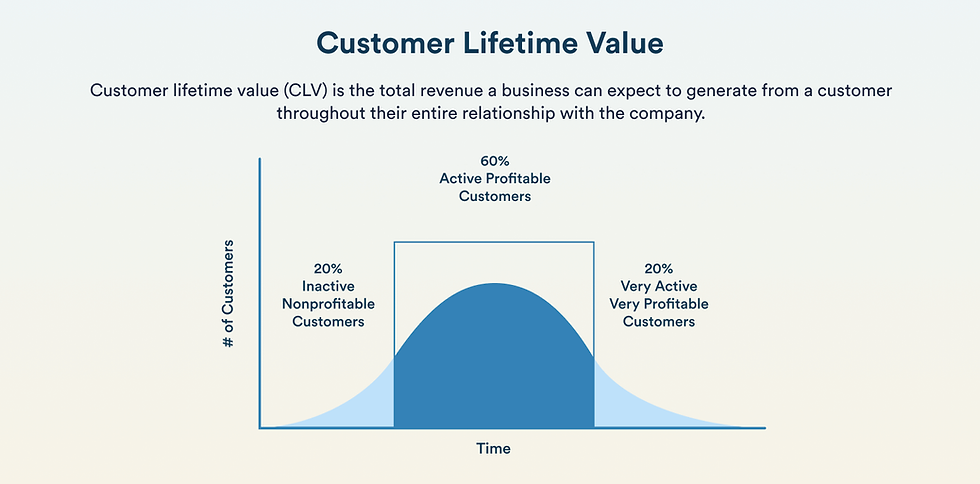
Customer Lifetime Value (CLV)
Customer Lifetime Value (CLV) is an important metric that helps businesses understand the long-term revenue potential of each customer.
By calculating how much revenue a customer is expected to generate over the course of their relationship with your business, CLV provides insight into the effectiveness and sustainability of your marketing efforts.
For businesses focused on measuring digital marketing effectiveness, this metric is indispensable.
CLV = Average Purchase Value × Purchase Frequency × Customer Lifespan
CLV estimates the total revenue a business can expect from a single customer over time, taking into account factors like purchase frequency, average order value, and customer retention rate.
For example, if a customer spends $200 per purchase, buys three times per year, and remains a customer for five years, the CLV would be $3,000.
CLV is a foundational digital marketing performance metric because it helps businesses understand the true value of acquiring and retaining customers.
Tracking CLV alongside other digital advertising metrics ensures that your marketing efforts are aligned with long-term business growth rather than just short-term wins.
By monitoring Customer Lifetime Value, businesses can better understand the long-term impact of their marketing strategies, making it one of the most important measuring digital marketing effectiveness metrics. It transforms raw data into actionable insights that drive revenue, loyalty, and sustained growth.
Conclusion
Understanding and tracking digital marketing metrics and KPIs is essential for businesses looking to grow, optimize campaigns, and make data-driven decisions.
From ROAS and conversion rate to CLV and traffic sources, each metric provides unique insights into the effectiveness of your marketing strategies.
These advertising metrics and KPIs allow you to identify what’s working, uncover opportunities for improvement, and ultimately drive measurable results.
By consistently monitoring the top marketing KPIs, businesses can optimize ad spend, improve campaign performance, and focus on strategies that deliver real ROI.
Whether you’re managing paid advertising, SEO, or social media campaigns, knowing which metrics to track ensures every decision is backed by actionable data.
To take your marketing efforts even further, learn how to grow your business using data-driven marketing with our complete free e-book guide on how to build your business's online presence in 90 days.
This guide provides comprehensive strategies, tools, and insights to help you leverage digital marketing metrics and KPIs effectively, empowering your business to achieve sustainable growth and measurable success.


%20-%20Text%20%26%20Icon%20-%20White%20(PNG)_edited.png)
Comments